

The precondition of a working society is mutual trust. “Society” is just a bunch of deals — “mutually beneficial trades”, as economists call them or “win-win deals” as marketers with a better ear for language do — and the precondition to enter a deal with someone is trusting them as a counter-party. Trusting them to keep up their end of the deal, so that you can actually benefit from it actually going through; but also trusting them in a more basic way: trusting them not to actively harm you. You’d rather take a loan from a bank than a loanshark, even if the rates were worse and the reason is right there in the name loanshark — this is not a safe person to deal with.
So, society is a bunch of deals and deals require mutual trust, which entails being safe or, at the very least the ability to perform being safe. The way you perform being safe is by being a normal person: can you perform the basic social rituals? “Good, how are you?” “Watch the game last night?” Etc. Each serves as a hoop you have to jump through until you eventually get categorized as “normal”, until you eventually get categorized as safe.
A “weirdo” is someone who — by disposition or cultivation — cannot perform the basic social rituals.
That’s bad.
Normies live and die by their basic social rituals. (They ought to be called “normers”, really: those who enforce norms.) And that’s GOOD! These little rituals are just the tip of the iceberg that are our shared norms and our shared norms are GOOD! They’re the cause and consequence of self-domestication, of selecting for cooperativeness, and societies that can enforce them not only trade more but also cooperate more and scale better, eventually outcompeting those that cannot.
And that’s why normies distrust weirdos: if you cannot perform the nearly costless basic social rituals… how can I trust you to perform the important, costly ones?
As a weirdo this can feel unfair to be on the receiving end of, but it’s not unreasonable.
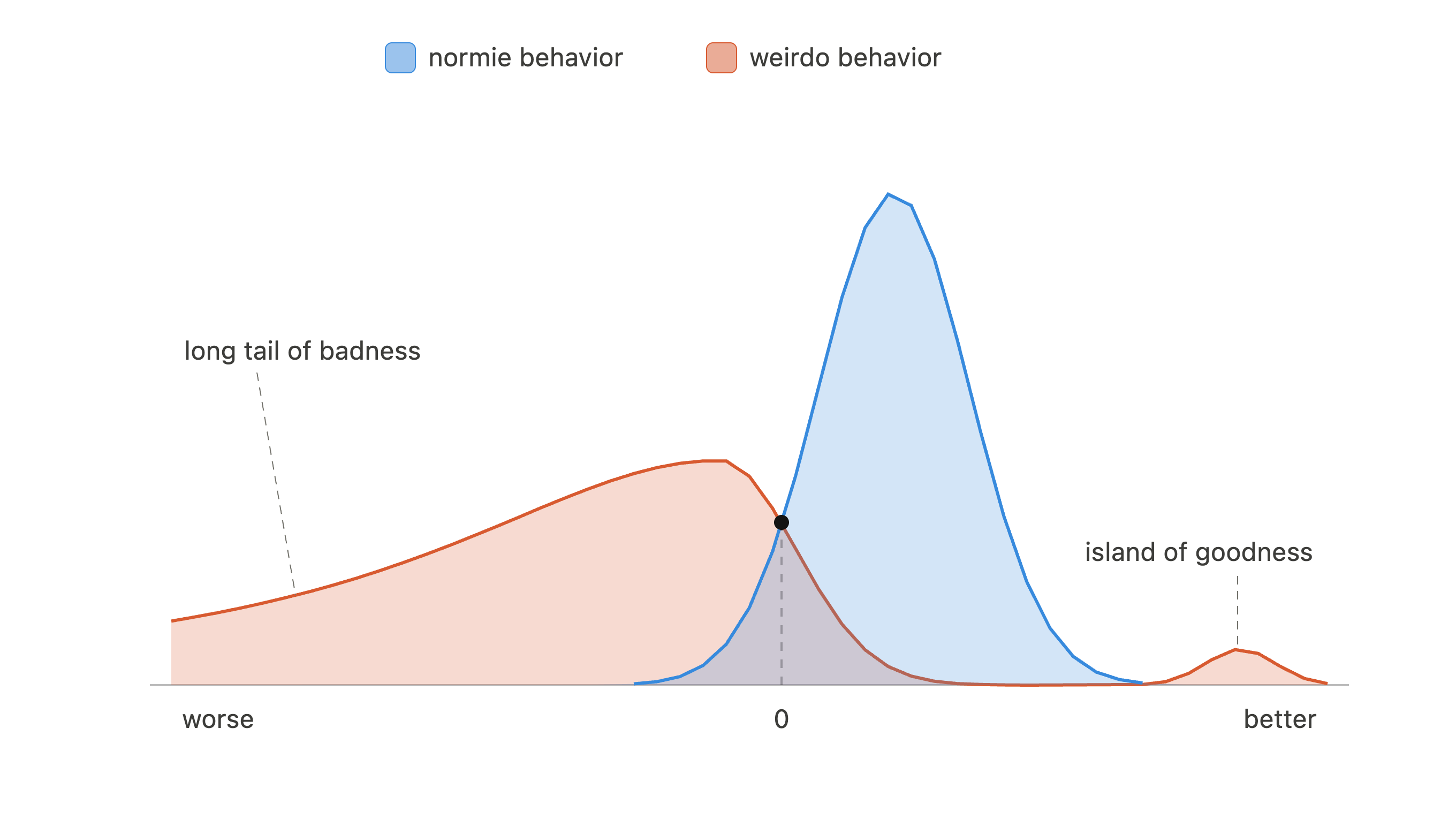
Destruction is easier than construction (all that’s necessary for society to crumble is for normie men to do nothing) which means that once someone is stepping outside tested-and-true (i.e. normal i.e. normie i.e. normed i.e. selected-for) behavior the odds are higher than not that their behavior is going to be a net negative. There’s no time to do deep dives on everyone and as a cheap-and-dirty heuristic it works.
Where normies’ “If you’re a weirdo, you’re bad” heuristic fails — and, again, it mostly works: for each “good weirdo” there’s a prison-size population of bad ones — where it fails is that, once in a blue moon, a weirdo actually is that guy: he doesn’t follow the norms, yes. Because he makes up new better ones.
But that’s the exception, not the rule. And thus, generally, normies are right to mistrust weirdos.
> “normers”, really: those who enforce norms
Great coinage
An important corollary to this is that normal behavior can be taught. And should be!
I was a weird kid (and, hell, a weird grown-up), and it would have been helpful if someone had pulled me aside and instructed me how to be a bit more normal.