
“Open Memetics Institute”
Are we at the frontier of a new scientific field, or just crackpots?

Sunday, 16th November, 2025.
I’m at the Love Symposium, in San Francisco. “A conference for people trying to solve modern relationships.” I don’t super care about the topic but got invited to come and have two friends giving talks:
, on his experiences matchmaking, and , on memetics.Chris’s talk left me with the distinct feeling that there is an adverse selection effect where people who request matchmaking can’t be helped by it. I refrained from asking about it during the talk’s Q&A section. Later he told me he thought it was right.
Defender’s talk was more hopeful. He was co-presenting with collaborator Joshua, both donning their signature yellow hats.
The talk was about a social “mini-game” they play online. When I was young me and my friends used to play the “No” game when going out. The goal was to hear as many “No”s as we could, mostly from girls. Oftentimes we would “fail” by ending up making out with a girl. I’m sure this illustrates why mini-games can be great. But they’re not limited to 15 year olds nor to picking up girls.
“Anatomy of Internet Arguments” started as an online series: a post-mortem of successful internet arguments, later becoming the name for the mini-game they were presenting on. The rules are as follows:
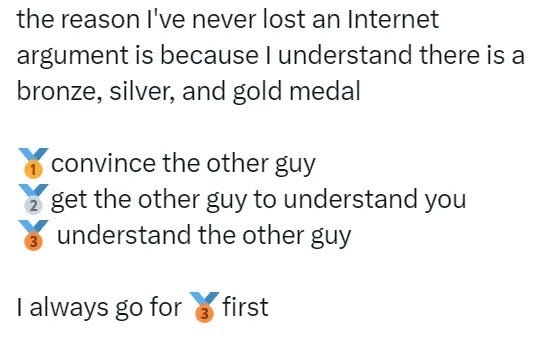
The genius of the game is like the genius of the game of “No”s. In the latter, if you fail to hear a ‘No’, you are now in a conversation with a girl. In the former, if you fail to convince the other guy, you still learn something. If you both disagree and are engaging in good faith in all likelihood by understanding them you will learn something, even if you don’t convince them. Either you have a no or you’re in a conversation with a girl. Either you convince them or you learn something. Can’t lose and can’t lose.
That’s what their talk was about. But this mini-game is but part of a much grander plan. The next day we met at Lighthaven to discuss it.
Lighthaven
Lighthaven is officially a “space dedicated to hosting events and programs that help people think better and to improve humanity’s long-term trajectory.” It’s also the rationalists’ headquarters. I’m there for Inkhaven, a thirty day writing residency. That’s what brought me to SF in the first place.
Anyways, Defender and Joshua arrive. We go to the “Bayes Building” (...) to an attic with carpeted floors and a whiteboard. We inadvertently expel the person who was writing there as they begin giving me a presentation.
The Open Memetics Institute
Something I had noticed before, talking to Defender and Joshua, was that there was a large inferential distance to be breached. Although we could all recognize one another’s work we don’t fully understand it. A lot of the conversation would be stilted by the need to build intermediary bridges: “Do you know what a hash is? Do you know what a bloom filter is?” (No, and no.)
Thankfully the goal of this presentation was to get me up to speed on how they, at OMI, are thinking about this whole thing.
Or, as they’d say:
Slide from the presentation. For some reason I always hear it as “beeflore”.
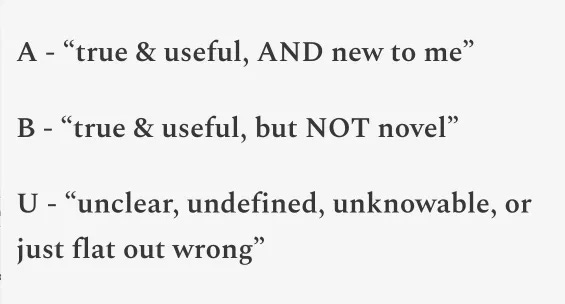
“B” being a short-hand, and part of the key table above designed to to raise the speed of bridging: “That’s an A for me”, “That’s a U”, etc.
Before I fully get into it I want to share some quick credentials. 1) I was in Crypto in 2017. Even though this wasn’t early early it was still early enough to see BTC touch 20k and then fall back down to 3k (do NOT ask me at what price I bought and at what price I sold); and 2) I was into LW in 2012. I consider this early for (modern) AI.
I share these to say that I somewhat trust my taste of what is or can become real. And I think this is real.
Goddamn it when are you gonna finally address the Open Memetics Institute
Hold your horses, it’s called seduction and if you had played the No game you’d get it.
Many years ago I was at the Emergent Ventures Unconference. There I met this filmmaker, “Olga”. I could not stand her. Her speech made no sense, it was just inchoate rambling. Thankfully I had my friend @utotransluence with me, who said “Oh, she’s just like Kanye! She thinks in vibes: Vibe — Vibe — Vibe!”. And it was such a gift. From that moment on not only did I understand “Olga”, I adored her.
This to say I was equipped to take on this less than perfectly structured presentation.
is a man who’s visibly overflowing with ideas and who needs more than one brain to organize them. I organize ideas professionally, so I was happy to lend mine.Again: the goal was to raise our shared “B” “floor”—the amount of statements we would agree were true and useful. He called these the OMI “Axioms”. I’d call them the “OMI” beats, as in, the beats he was hitting in his presentation. From these vibes I was meant to triangulate to a gestalt.
These were some of the beats the presentation hit
OMI’s Long Term Plan
People pushing the frontier of memetics
The Idea Provenance Problem
The Memetic Safety Debate
The Open Memetics Journal
Rigorous Subjectivity
Objects of study
Open Questions
(You can them in detail here, good luck.)
We had several detours, which you can see on the board pictures below. One for discussing to what extent wasn’t this just politics (the Open Memetics Institute is… open), another for noticing how there was an analogy to the AI Safety debate (it’s unclear when being open can be bad since somethings get get destroyed by it), one on a test of epistemics/inference (use Zero Knowledge Proofs to test whether someone can correctly infer to proprietary knowledge), one on mapping out the coverage of your memetic reach (how many things that hit the mainstream are you surprised by versus expecting to?), and one on finding your “Egregoric Diversity Quotient” (I don’t want to give too much away on that one, but you can test yourself here.)
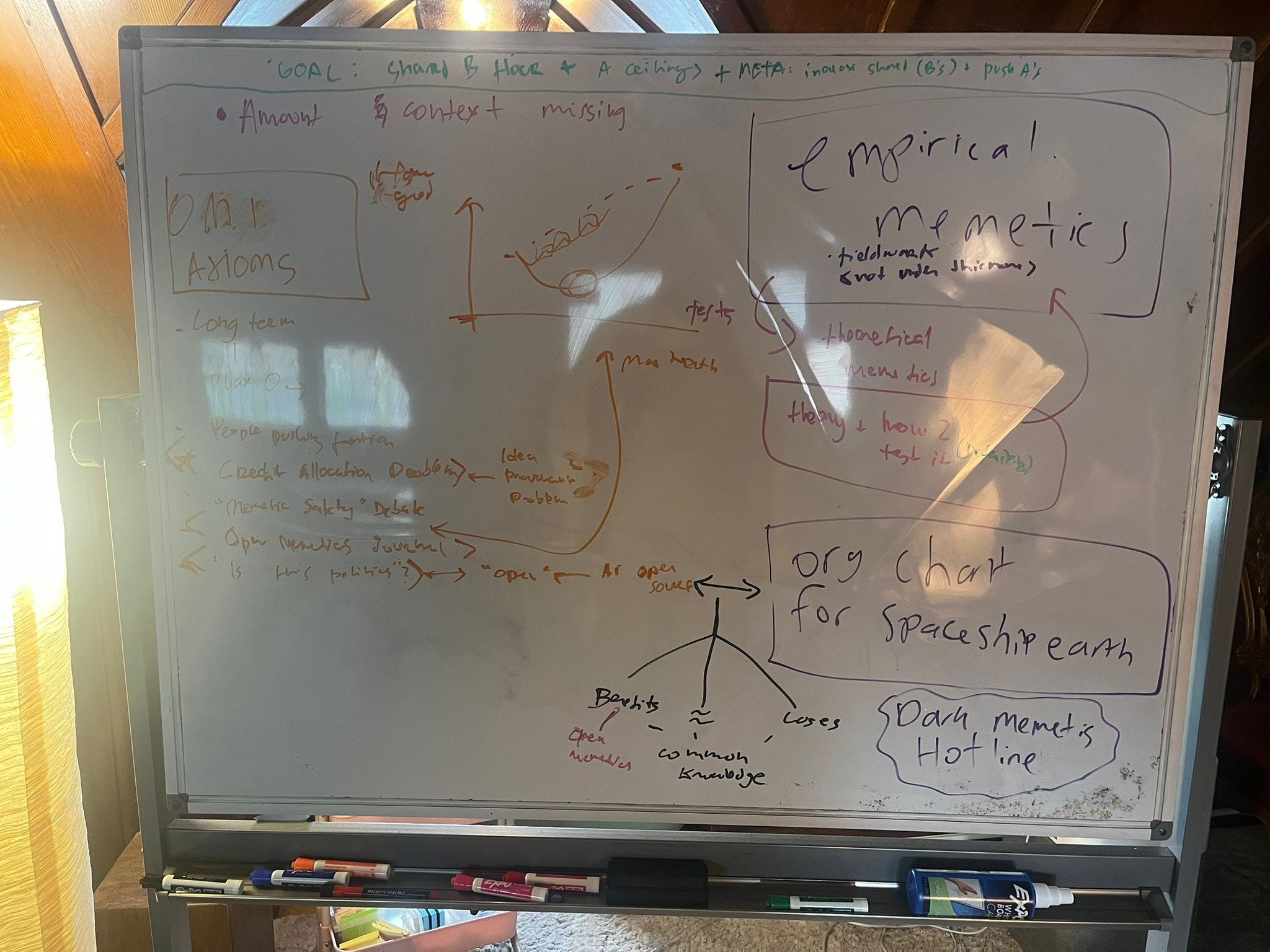
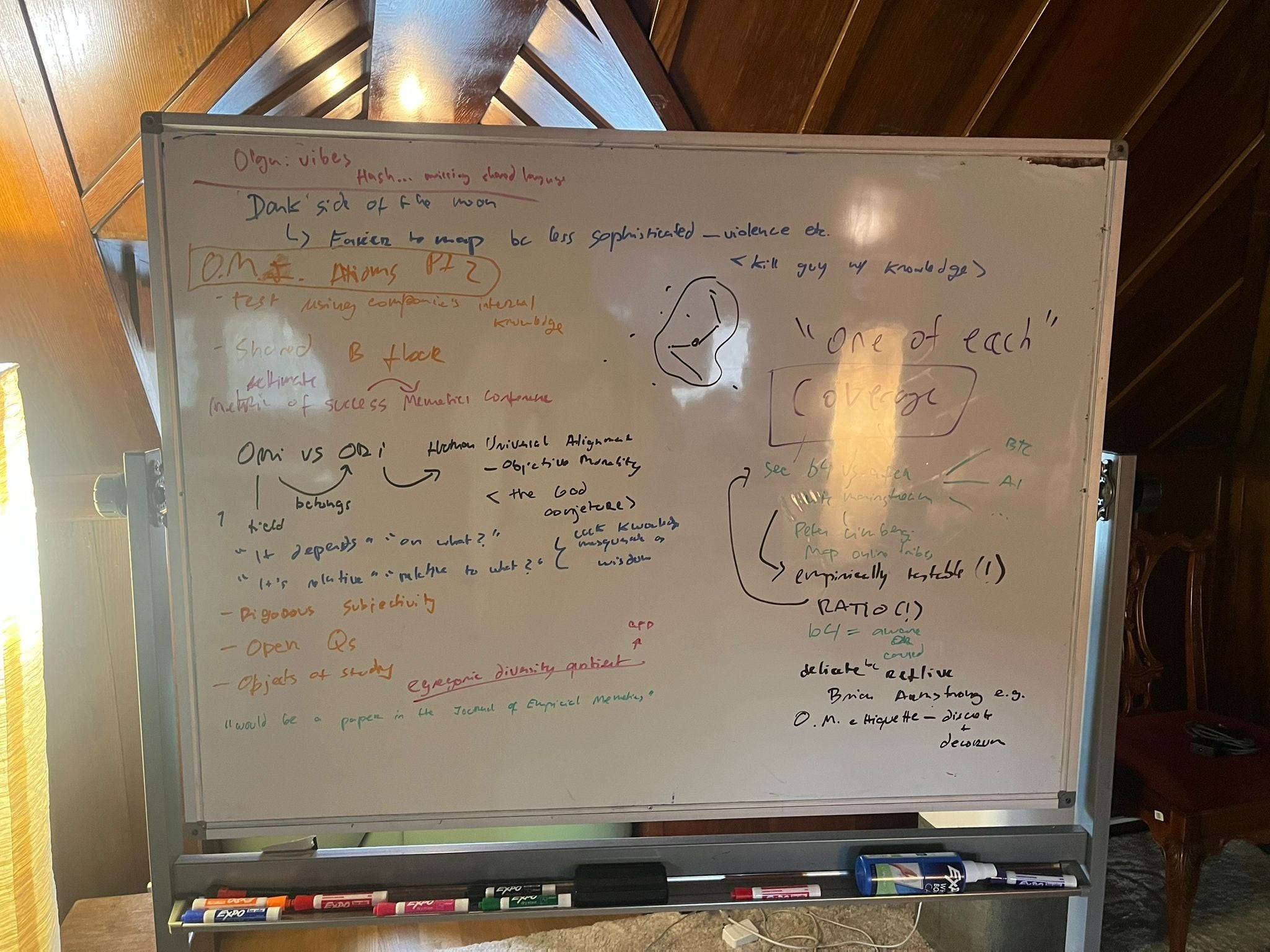
There was also a small detour into solving morality objectively but I won’t get into that here.
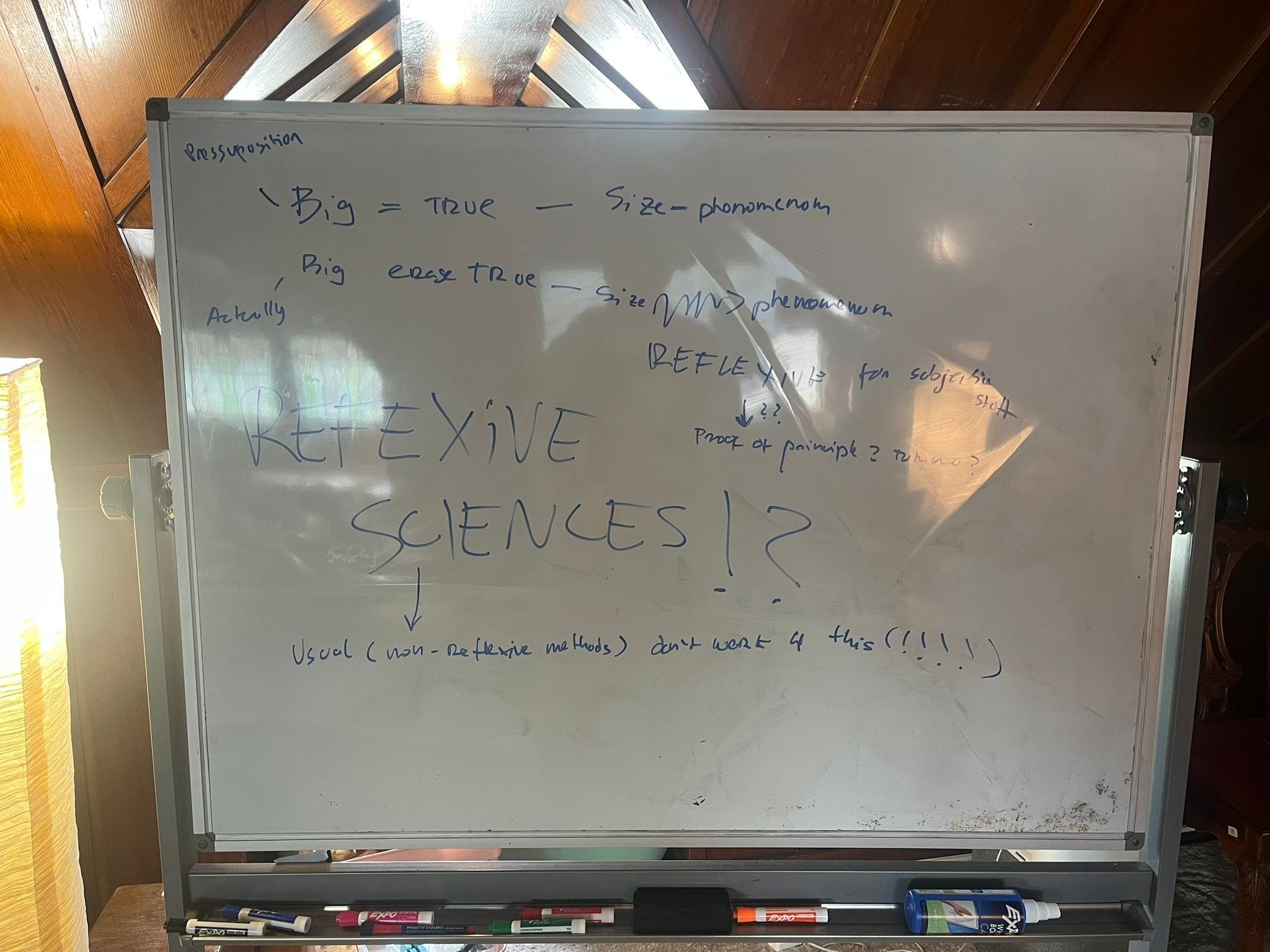
And another one into me realizing that for studies of interior phenomena (meditation) there is a tension between how many people you get to follow the instructions and how well they’re followed, in expectation. Here having a bigger sample size would erase the phenomenon you care to study. This was an “A” for me. I now suspect “interior” science is necessarily reflexive—part of why it is so hard.
At this point I need to shift gears from this biopic play-by-play that is very fun to write into something a bit more structured lest you leave this post full of U’s instead of A’s.
Below is my understanding of what the Open Memetics Institute is up to. All errors mine, yadayadayada.
The Open Memetics Institute is an organisation at the budding field of memetics.
It has three goals:
To make (currently ongoing) epistemic warfare visible;
To grow a bubble safe from it;
To set-up clean information highways among hierarchies.
Defender illustrated “3” with the Janitor & CEO test: as a CEO you can just feed your Janitor info you’d want to go up the hierarchy and check if it actually does. Ideally you have maximally smooth communication going both ways.
“2” kinda follows from “1” and “1”, as you might be aware, is a soft obsession of mine.
The objects of study are “memes” and “egregores”. (N.B.: These terms should be taken with huge grains of salt. Part of the research that needs to be done is to operationalise these terms, test those operationalisations, and so on. It’s kinda like you get into a new forest and are asking “What is here?”—if you knew the answer you’d be done. “Memetics” is just a bunch of people who collectively agree they are in the same new “forest”.)
Memetics is divided into Theoretical Memetics and Applied or Practical or Empirical Memetics. Properly defining terms falls into the former, as does the problem of reflexivity above, and the Safety Debate. Empirical Memetics would include things as grand as a future Open Intelligence Agency but also things like the “Anatomy of Internet Arguments” game—like, what’s your hit-rate? If your memetics game (i.e. your theory) is great then you should get lots of gold (changing people’s minds) medals. Do you?
So you see how even this seemingly trivial game is an operationalisation of the budding field—part of a much grander structure.
This is what the board looked like when I tried to describe back to them my understanding of what I had just heard:
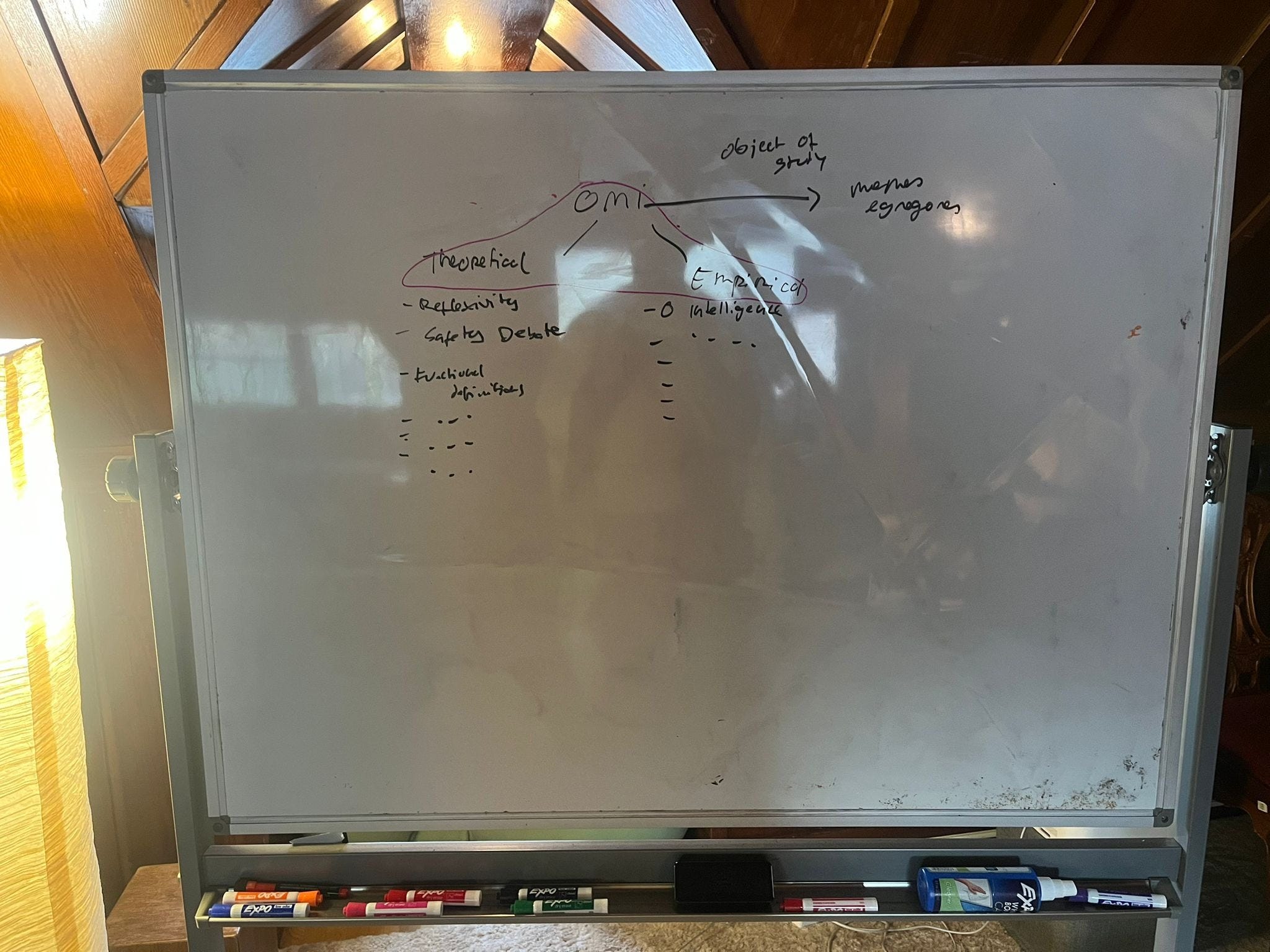
You might be surprised to learn it but I’m a preternaturally organised person.
So, what are we doing here, you might ask.
Well—Joshua, Defender, I, and a few others, have been going around in the same forest for the longest time. From afar we recognise one another “Hey, I see you over there!”. Necessarily we don’t have insight into one another’s part of the forest but we can kinda already tell we’re all in the same forest. Morphenius is obsessed with reflexivity (a theoretical question) and giving his own take on the forest itself. I’m softly obsessed with epistemic warfare (ofc). Defender is doing lots of field work. And now he’s getting people together too.
Because there is a question you can’t avoid when you’re looking at what you think is a new field: Am I crazy? Or is there a there there here? And it’s really hard to know, unless you have collaborators, or other people who understand.
Another name for those other people who understand could be peers. It’s hard to say unless you have peers who can review your work. Peer review. (Rectification of names wenn).
This meeting felt like a meeting of peers. By the end I was convinced that (1) there’s a there there in Memetics and that (2) a gathering of these people needs to happen sooner rather than later.
That’s why I’m excited to announce that the first Unconference on Memetics will be happening in 2026. Mark your calendars.
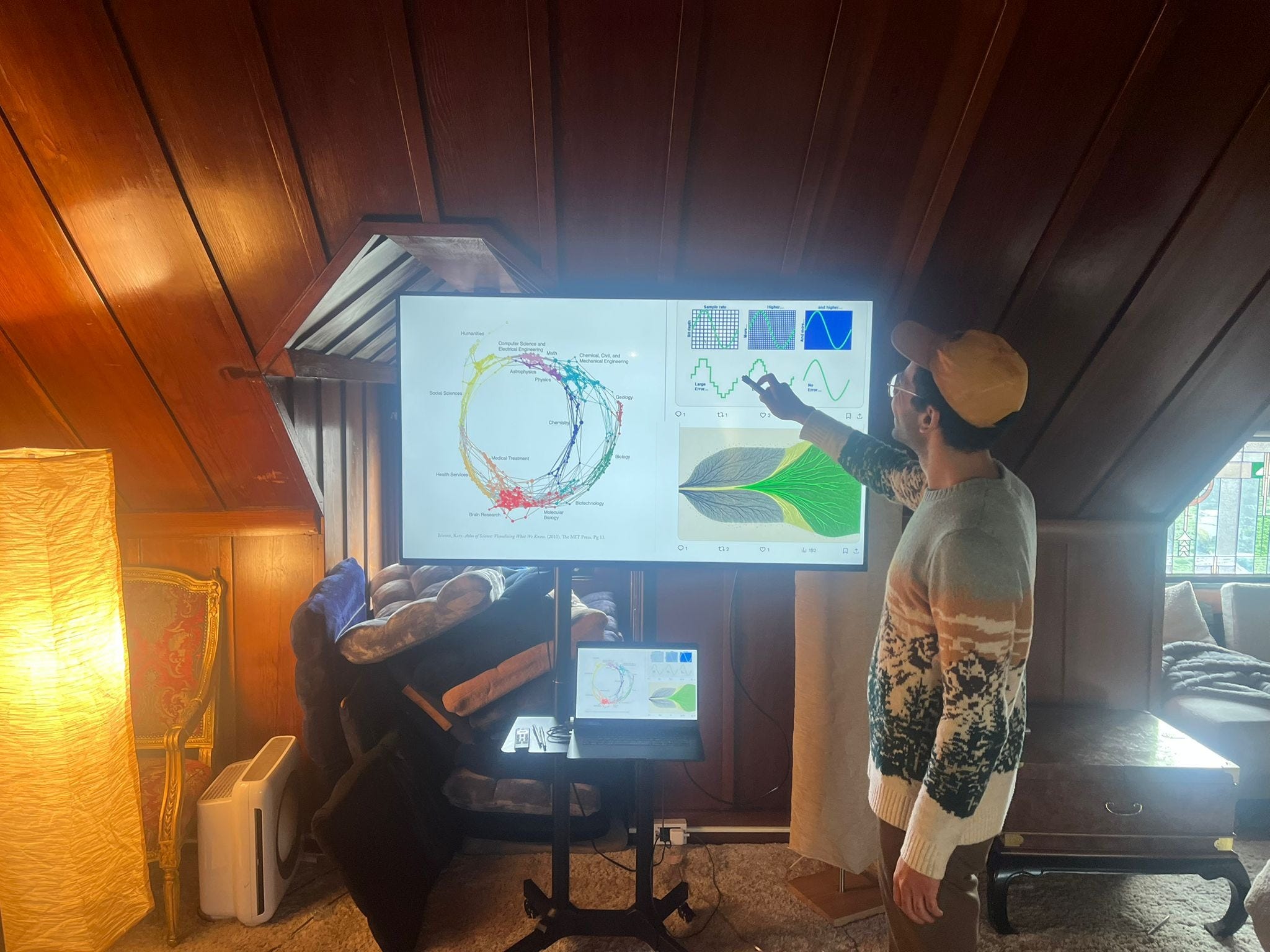
There will be a lot of this.
P.S. One of the most frustrating experiences at Inkhaven so far has been that people ask me what I’ve been writing about for the day and my answer always is that if I could explain it simply, I wouldn’t have needed to write about it. I feel similarly here: if we could share these simply over text I wouldn’t have needed a 2-hour personal presentation. If you want to get your personal 2-hour presentation on memetics, come through next year.
I am studying antimemetics right now, and I would like to have a conversation with someone in your circles. I think you would be interested in what I've found.
interesting 👀